Charting mobility patterns in the scientific knowledge landscape
2026.06Singh, C. K., Tupikina, L., Lécuyer, F., Starnini, M., & Santolini, M. (2024). Charting mobility patterns in the scientific knowledge landscape. EPJ Data Science, 13:12. https://doi.org/10.1140/epjds/s13688-024-00451-8
Abstract
과학 지식 지형(지식 공간)에서의 이동 패턴을 체계적으로 연구하여, 과학적 발견 과정을 공간 이동에 비유하던 은유적 아이디어를 공식적이고 과학적인 용어로 구체화한 연구다. 저차원 임베딩 기법으로 물리학·컴퓨터과학·수학 분야의 논문 150만 편으로 이루어진 knowledge space를 구축했고, 그 결과 과학적 이동 패턴이 실제 사람들의 물리적 공간 이동과 매우 유사하다는 것을 발견했다.
새로운 연구로의 도약은 논문 밀도가 높은 영역에서 일어날 확률이 높고, 기존 연구와 거리가 먼 영역으로 이동할 확률은 낮아진다. 연구자는 두 유형으로 나뉜다.
- explorers — 학문을 넘나들며 새로운 분야를 개척하는 유형
- exploiters — 특정 전문 분야에 머무르며 지식을 파고드는 유형
A systematic study of mobility patterns across the landscape of scientific knowledge, turning the long-standing metaphor of discovery-as-travel into formal, measurable terms. Using low-dimensional embedding techniques, the authors build a knowledge space out of 1.5 million papers in physics, computer science and mathematics — and find that scientific mobility closely resembles the physical mobility of people in real space.
Jumps into new research are more likely to land in densely populated regions, and less likely the farther they fall from a researcher’s existing work. Researchers divide into two types:
- explorers — those who cross disciplines and open up new territory
- exploiters — those who stay within a specialism and dig deeper
Introduction
연구자들의 논문 발표 궤적을 살피는 일은 과학 발전의 근간을 이루는 복잡한 과정을 파악하는 데 도움이 된다.
Tracing researchers’ publication trajectories helps us grasp the complex processes that underlie the advance of science.
참고할 만한 논문 — Tuninetti, M., Aleta, A., Paolotti, D., Moreno, Y., & Starnini, M. (2021). Prediction of new scientific collaborations through multiplex networks. EPJ Data Sci 10(1):25. 연구자 간 과학적 신뢰도와 상호 관심도(각각 인용 횟수와 키워드로 정량화)를 결합해 새로운 협력 가능성을 더 정확히 예측한다.
Worth reading alongside — Tuninetti, M., Aleta, A., Paolotti, D., Moreno, Y., & Starnini, M. (2021). Prediction of new scientific collaborations through multiplex networks. EPJ Data Sci 10(1):25. It combines scientific credibility and mutual interest between researchers (quantified by citation counts and keywords respectively) to predict new collaborations more accurately.
중력 모델The gravity model
물리학에서 두 물체 사이의 중력이 질량이 클수록·거리가 가까울수록 강해지듯, 같은 원리가 연구자들의 주제 이동 패턴에서도 나타난다.
- 분야의 인구수와 밀도(질량) — 이미 많은 연구자가 방문해 논문을 출판한 분야일수록 질량이 큰 행성처럼 강하게 끌어당긴다. 연구자들은 논문 밀도가 높은 영역으로 이동할 확률이 높다.
- 주제 간 인지적 거리 — 거리가 멀수록 중력이 약해지듯, 연구자들이 기존 연구에서 너무 멀리 떨어진 생소한 분야로 한 번에 건너뛸 확률은 낮다.
Just as gravity between two bodies grows with mass and weakens with distance, the same principle appears in how researchers move between topics.
- Population and density of a field (its mass) — the more researchers have already visited a topic and published there, the more strongly it pulls, like a heavier planet. Movement is most likely toward dense, well-populated regions.
- Cognitive distance between topics — as gravity weakens with distance, researchers rarely leap in one step into an unfamiliar field far from their existing work.
연구 방법Method
arXiv 프리프린트의 출판 메타데이터(1992–2018년 게재된 1,456,403편)에 임베딩 기법을 적용해, 서로 다른 주제와 분야 사이의 관계를 정량화하고 과학적 지형의 본질을 포착하는 저차원 지식 공간을 구축했다. 이렇게 얻은 임베딩 위에서, 저자 식별(disambiguation)을 거친 연구자들의 출판 기록으로 그들의 이동을 추적했다.
The authors apply embedding techniques to the publication metadata of arXiv preprints (1,456,403 papers posted between 1992 and 2018), quantifying the relationships between topics and fields to build a low-dimensional knowledge space that captures the shape of the scientific landscape. On that embedding, they track researchers’ movement using disambiguated author publication records.
참고할 만한 논문 — Clement, C. B., Bierbaum, M., O’Keeffe, K. P., & Alemi, A. A. (2019). On the use of arXiv as a dataset. arXiv:1905.00075
Worth reading alongside — Clement, C. B., Bierbaum, M., O’Keeffe, K. P., & Alemi, A. A. (2019). On the use of arXiv as a dataset. arXiv:1905.00075
결과Results
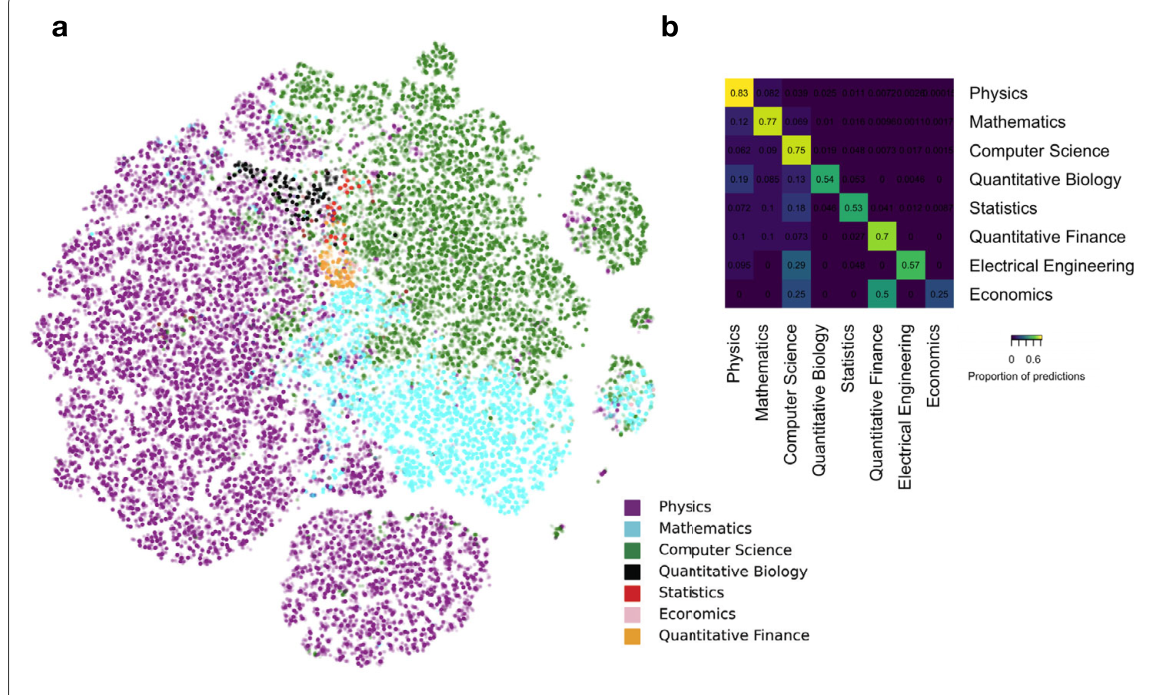
tSNE로 초기 공간을 2차원에 임베딩해 차원을 축소했고, 관찰된 클러스터링을 정량적으로 검증하기 위해 데이터의 70%로 k-최근접 이웃 분류를 수행했다.
The initial space is reduced to two dimensions with tSNE, and the observed clustering is validated quantitatively by k-nearest-neighbour classification on 70% of the data.
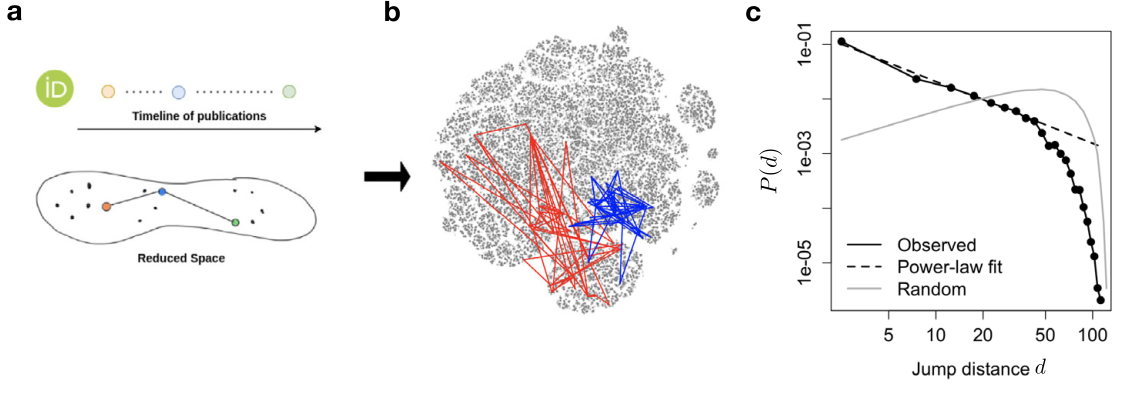
연구자들의 이동은 무작위가 아니다. 거듭제곱 법칙을 따른다는 것은 대부분의 점프가 아주 짧고(원래 관심사 가까이에서 맴돌고), 극히 일부만이 지식 공간을 가로지르는 먼 이동(long jump)이라는 뜻이다. 또한 실제로 더 많은 연구가 이루어진 밀집 지역이 존재한다.
Movement is not random. A power law means most jumps are very short — researchers circle close to their original interests — and only a few are long jumps across the knowledge space. Dense, heavily worked regions genuinely exist.
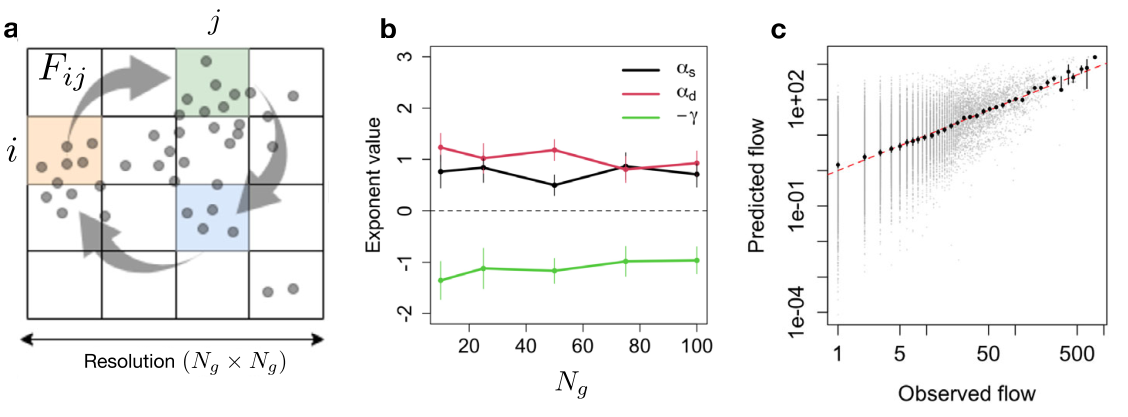
Ng는 해상도 수준을 정량화하는 매개변수이며, 인구 수는 격자 수준에서 집계된다.
- 격자 셀이 클수록 장거리 도약이나 토픽 전환을 주로 포착하고, 셀이 작을수록 인접 토픽으로의 국소적 도약을 더 많이 포착한다. (저자의 연속된 두 논문이 적어도 하나의 필드 태그를 공유하면 동일 주제로 간주)
Ng is the parameter that quantifies the resolution level; population is aggregated at the grid level.
- Larger cells mainly capture long jumps and topic switches; smaller cells capture more local hops to adjacent topics. (Two consecutive papers by an author are treated as the same topic if they share at least one field tag.)
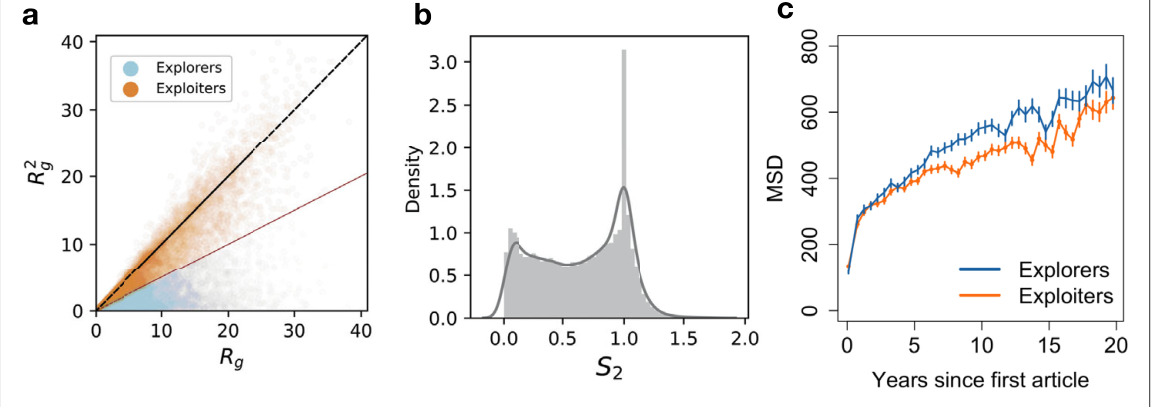
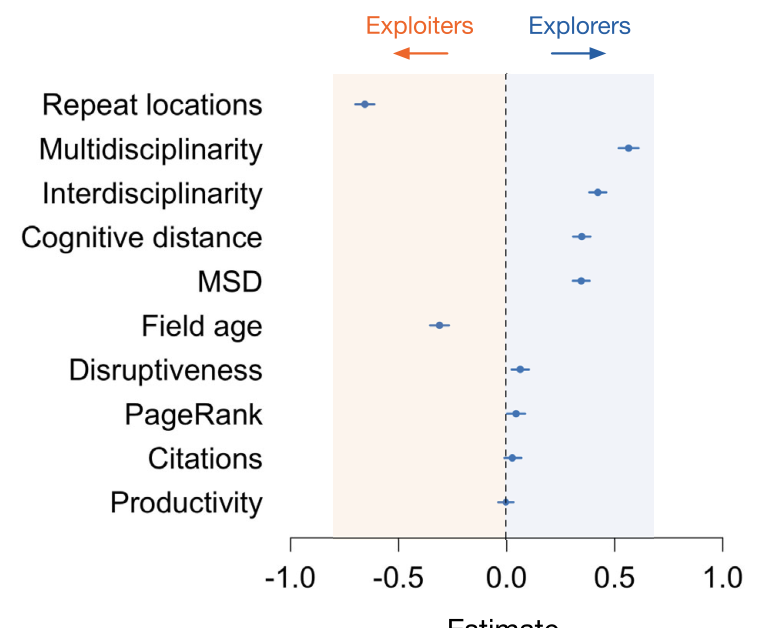
탐험가들은 커리어 중반(5–15년 차)에 지식 공간을 훨씬 넓게 개척하지만, 20년 차 이상 시니어가 되면 두 집단 모두 기존 연구를 활용하는 쪽으로 안주하는 경향을 보인다. 한편 생산성이나 논문의 단순 최대 인용 수는 두 집단 사이에 큰 차이가 없었다.
Explorers cover far more ground mid-career (years 5–15), but past twenty years both groups settle toward exploiting what they already have. Productivity and simple maximum citation counts, meanwhile, differ little between the two.
Discussion
- 혁신과, 기존 성과를 깊이 파고드는 전통 사이에서 과학계가 겪는 필수적 긴장 관계(essential tension)를 실증적으로 보여주는 결과다.
- 여러 학문을 가로지르는 연구자들이 장기적으로는 연구비 확보 등에서 더 큰 성공을 거두는 경향이 있다.
- 이 연구는 개별 연구자의 궤적에 초점을 맞추었지만, 현대 과학의 혁신은 대부분 팀 단위로 이루어진다. 개별 연구자의 상호작용과 팀 궤적을 묶어 분석하는 후속 연구가 필요하다.
- 피인용 수, 분야의 연차, 배정된 연구비 같은 외부 속성을 더해 이른바 딥 중력 모델을 구축한다면, 연구 지원 기관이 정책을 세우고 연구의 질을 평가하는 데 유용한 도구가 될 수 있다.
Disruptive Index (DI) — 논문의 혁신성을 수치화하기 위해, 후속 논문들이 이 논문만 인용하는지(혁신적) 아니면 이 논문이 참고한 과거 문헌까지 함께 인용하는지(기존 연구의 연장)의 비율을 계산한다.
- The findings give empirical form to the essential tension science lives with — between innovation and the tradition of digging deeper into established work.
- Researchers who cross disciplines tend, over the long run, to be more successful at securing funding.
- The study follows individual trajectories, but modern scientific innovation is mostly done in teams; follow-up work should analyse interactions between researchers and team-level trajectories together.
- Adding external attributes — citation counts, the age of a field, allocated funding — would yield a “deep gravity model” that funding agencies could use to shape policy and assess research quality.
Disruptive Index (DI) — to quantify a paper’s novelty, it measures the ratio of later papers that cite the paper alone (disruptive) against those that also cite its own references (a continuation of existing work).